
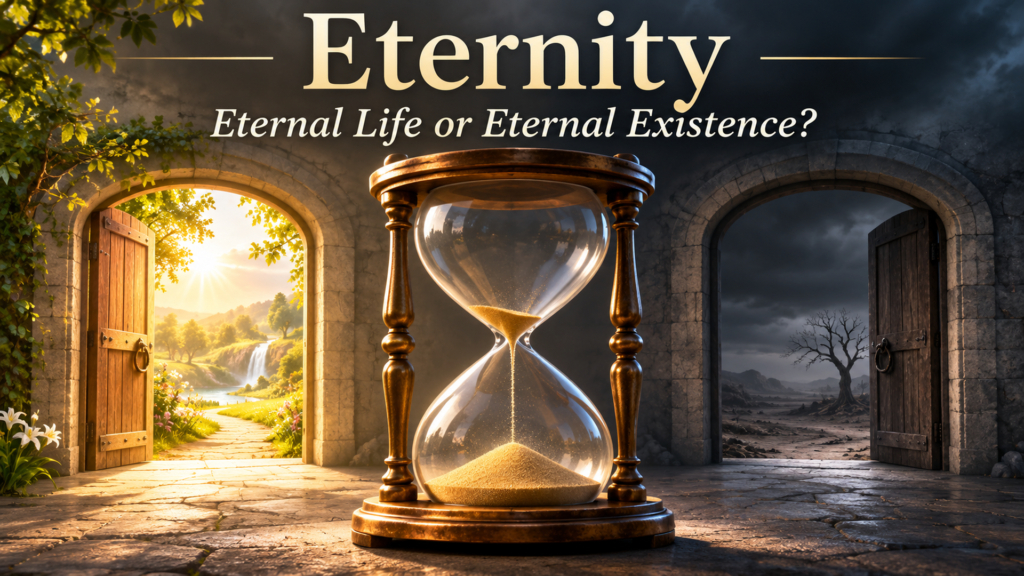
Eternity is a term that simply means “no end.” Time limits everything in our world. Ecclesiastes tells us, “There is an appointed time for everything. And there is a time for every matter under heaven.” (3:1)
This limitation of time exists “under heaven,” meaning life on earth. Verse 2 says, “A time to be born, and a time to die.” This is the most fundamental reality for every person. We only have to consider the trees in autumn and spring. Every autumn, the leaves die and fall to the ground. In spring, new leaves appear.
This would be depressing information if death meant that we cease to exist. The good news is that humans are eternal beings.
Understanding Eternity
The big question is where you and I will spend eternity. The Bible refers to two eternal places: heaven and hell. Jesus repeatedly referred to eternal life.
Eternal life means much more than a never-ending existence. In John 10:10, Jesus put it this way:
“I came so that they would have life, and have it abundantly.”
The Greek word translated “abundantly” comes from perissos. It conveys the idea of exceeding the ordinary or going beyond measure.
In this message, I will use the term “Eternal Existence” to describe an everlasting existence apart from God’s goodness. This distinguishes it from the eternal life God offers us through Jesus Christ.
Does Death End Our Existence?
Before we go further, it must be understood that death does not mean people cease to exist. Physical death involves the separation of the soul from the body. Spiritual death involves separation from God. Consider what God told Adam would happen if he ate the forbidden fruit:
“But from the tree of the knowledge of good and evil you shall not eat, for on the day that you eat from it you will certainly die.” (Genesis 2:17)
Adam did not die physically on the day he ate the forbidden fruit. In fact, he lived to the age of 930 years. However, something very significant did happen on the day he and Eve ate the fruit. God expelled both of them from the Garden of Eden.
During their time in this garden, it appears that God interacted with them personally and on a regular basis. This all ended on the day they ate the fruit. For the first time, our original parents were separated from the tangible presence of God.
From this, we can safely conclude that death does not end our existence. Eternity still lies before us. This makes perfect sense when we consider Genesis 2:7:
“Then the LORD God formed the man of dust from the ground, and breathed into his nostrils the breath of life; and the man became a living person.”
God created Adam’s physical body from the dust of the ground (earthly, tangible elements). However, his life came directly from the breath of God, who is eternal. God created no other mortal being in this manner.
Many Bible scholars believe this passage describes the creation of man’s eternal soul.
Eternal Life and the Goodness of God
Every human being will exist eternally, but not all have eternal life. Each person must individually and willingly receive this gift from God. John 3:16 explains the process:
“For God so loved the world, that He gave His only Son, so that everyone who believes in Him will not perish, but have eternal life.”
God gave His Son, Jesus, so that we can have eternal life. Those who believe (trust) in Jesus will receive eternal life. Those who reject Him will perish, facing an eternity separated from God’s goodness.
Eternal life means more than being in God’s presence. It also means experiencing His goodness throughout eternity. Eternal Existence, by contrast, means the loss of all God’s goodness.
In this world, both believers and unbelievers experience God’s goodness. Examples include beautiful days, food, family, children, pleasant company, sleep, work, and countless other satisfying experiences.
Here’s how the Bible phrases it: “Every good thing given and every perfect gift is from above, coming down from the Father of lights, with whom there is no variation or shifting shadow.” (James 1:17)
Eternity: The Rich Man and Lazarus
In Luke 16:19–31, Jesus pulled back the curtain on existence after death. I’ll summarize the narrative:
Two men died. One went to paradise and was in the arms of Abraham. The other went to hell.
The man who went to hell was rich. He dressed in expensive clothes and “enjoyed himself with splendor every day” while he lived.
The other man was poor, disabled, and covered with sores. He longed for the scraps of food from the rich man’s table. His name was Lazarus, and he was laid at the gate of the rich man’s house every day. When he died, “…he was carried away by the angels to Abraham’s arms.”
The Great Divide
A great, impassable divide separated the two men in eternity.
The rich man was in torment and asked Abraham, “Father Abraham, have mercy on me and send Lazarus, so that he may dip the tip of his finger in water and cool off my tongue, for I am in agony in this flame.”
Abraham answered the rich man, saying, “Child, remember that during your life you received your good things, and likewise Lazarus bad things; but now he is being comforted here, and you are in agony. And besides all this, between us and you a great chasm has been set, so that those who want to go over from here to you will not be able, nor will any people cross over from there to us.”
It should be pointed out that the rich man was not in hell for being rich. Neither was Lazarus in paradise for being poor and disabled.
The rich man was in hell because he had no regard for God or his fellow man. Lazarus, on the other hand, was a man who trusted in God.
There is much to be learned from this passage in Luke 16. However, my purpose is to demonstrate that there is life after death and only two locations. One location is absolute bliss, and the other is eternal torment.
Where Will You Spend Eternity?
Sadly, the vast majority of people give little consideration to their eternal destination or how to obtain eternal life. Jesus Himself tells us that many follow the path to destruction, while only a few find the path to life (Matthew 7:13-14).
Yet this earthly life is brief. The average human lifespan worldwide is estimated to be only 73 years. The Bible says:
“Yet you do not know what your life will be like tomorrow. For you are just a vapor that appears for a little while, and then vanishes away.” (James 4:14)
The contrast between Eternal Life and Eternal Existence could not be greater. God promises no one tomorrow.
The Choice We Must Make
Jesus opened the way for eternal life, but no one is forced to enter. It is a choice every person must make, but there is a time limit. We must make this choice in this life. However, no one can be certain when they will die.
In speaking to His disciples, Jesus made this sobering remark:
“For what good will it do a person if he gains the whole world, but forfeits his soul?” (Matthew 16:26)
God knows that the human heart is driven to acquire as much as possible from this life. That’s what the rich man was doing in Luke 16.
Nearly two thousand years have passed since Jesus told of the rich man in torment. He has yet to receive that single drop of water to cool his tongue. It’s never coming because he forfeited the eternal goodness of God.
What about you? Are you in jeopardy of forfeiting your soul? Are you indifferent to the eternal life Jesus has provided? He greatly desires that you be with Him for all eternity in heaven. It was His choice to make salvation available to you. It is your choice whether to receive His gift.
Will it be Eternal Life or Eternal Existence?